























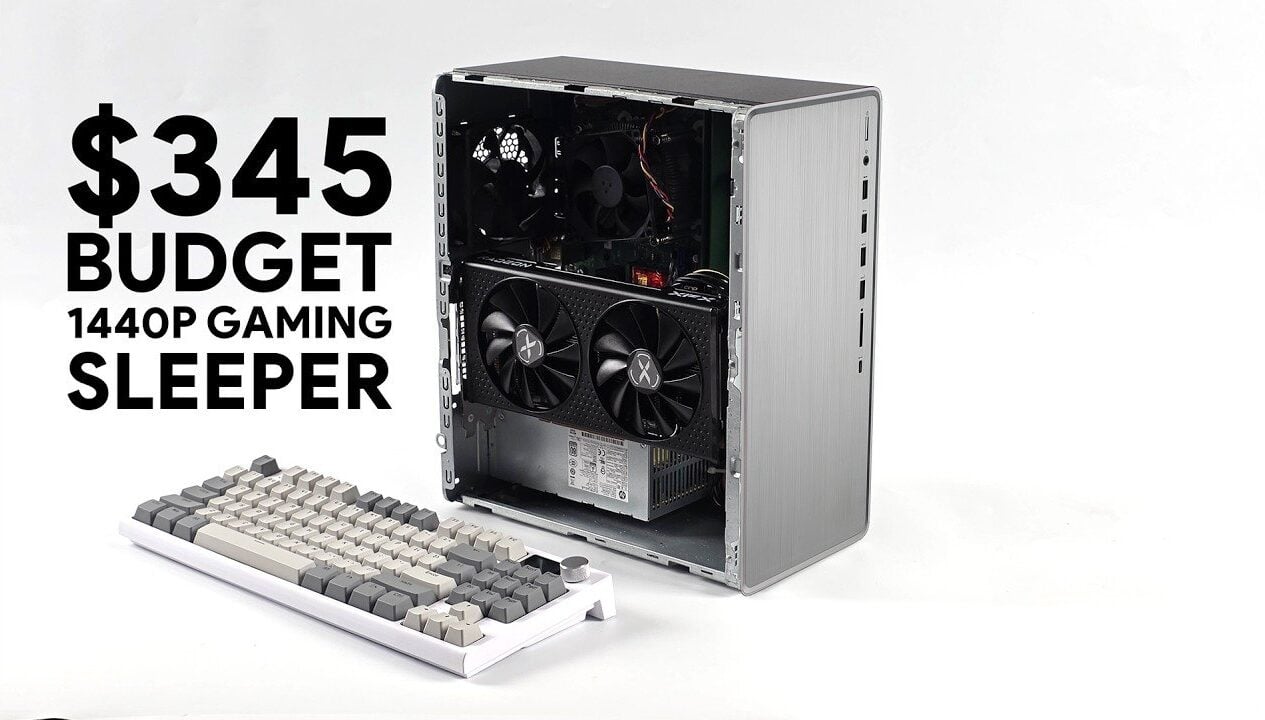
As the costs of gaming hardware continue to rise, many enthusiasts find themselves grappling with the perception that PC gaming has become an unattainable luxury. The significant price hikes in GPUs, CPUs, and RAM have made building a gaming rig that provides good performance without financial strain seem nearly impossible. However, a recent guide by ETA Prime presents a compelling counter-narrative, demonstrating that it is possible to construct a capable gaming PC for under $350, offering smooth 1440p gameplay.
By leveraging a keen eye for second-hand deals and strategically choosing components, ETA Prime transformed a modest prebuilt system into a robust gaming machine. The build centers around an HP Pavilion TG01, which was acquired for just $165 and features a Ryzen 7 5700G CPU alongside 16GB of DDR4 RAM and a 256GB SSD. To maximize gaming performance, an XFX Swift Radeon RX7600 GPU, priced at $180, was added. This budget-friendly combination unlocks impressive capabilities, allowing it to run modern titles such as Cyberpunk 2077 and Red Dead Redemption 2 at high settings.
The challenges of budget PC building have become increasingly pronounced, particularly due to surging hardware prices. However, exploring second-hand markets or repurposing prebuilt systems can yield powerful results. The HP Pavilion TG01 serves as an excellent example of how a second-hand system can provide essential components for a gaming build. With the Ryzen 7 5700G’s 8-core, 16-thread architecture, the system can handle both gaming and multitasking effectively. Coupled with 16GB of RAM operating at 3200 MHz, this foundation is more than adequate for modern gaming demands.
Performance optimization techniques played a vital role in achieving satisfactory results. Minor overclocking was applied to both the CPU and GPU, providing a boost in frame rates while ensuring system stability. The implementation of FidelityFX Super Resolution (FSR) further enhanced the gaming experience, allowing lower-resolution images to be upscaled to 1440p. This combination of strategies resulted in benchmark scores showcasing the system’s capabilities: 90 FPS in Red Dead Redemption 2, 100+ FPS in Forza Horizon 5, and even 110 FPS in Spider-Man 2 with FSR enabled.
For those interested in replicating this budget-friendly build, prioritizing value and compatibility is crucial. The total cost of the system was $345, illustrating that modern gaming is still within reach for those who approach it thoughtfully. The Radeon RX7600 operates on a PCIe 3.0 x8 interface in this setup, a limitation compared to the newer PCIe 4.0, but it hardly impacts gaming performance, proving to be a solid choice for this build.
In addition to performance gains, the discussion on storage cannot be overlooked. The 256GB SSD may suffice for operating systems and a few games, but the growing size of modern titles often necessitates additional storage solutions. External SSDs or larger internal drives can be a cost-effective means to expand storage capacity, ensuring versatility as gaming libraries grow.
As the gaming landscape continues to evolve, budget-conscious builders can draw valuable insights from this project. Focusing on newer Ryzen CPUs, exploring alternative graphics cards like the RX6600 or upcoming RTX 5050, and considering second-hand prebuilt systems can offer substantial savings without sacrificing performance. By utilizing technologies such as FSR, gamers can further enhance performance in supported titles, making PC gaming accessible even at a lower price point.
Ultimately, this budget gaming PC guide serves as a testament to the possibilities within the realm of affordable gaming. By carefully selecting components and optimizing performance through strategic tweaks, building a capable gaming rig for under $350 is not merely a dream but an achievable reality. This project not only challenges the notion of PC gaming as a luxury hobby but also reinvigorates the community’s belief in budget-friendly solutions.