













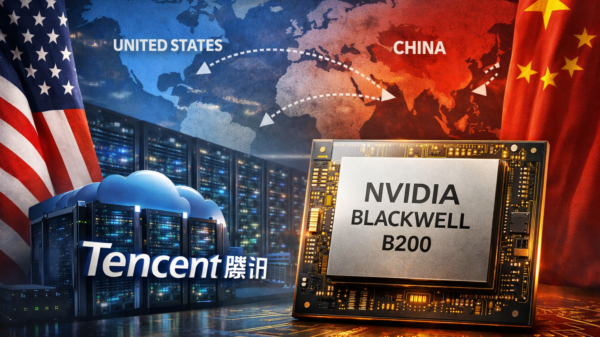















In a surprising turn of events, Tencent has found a way to access NVIDIA’s latest Blackwell generation of graphics processors, despite existing U.S. export controls that prohibit direct sales to China. This revelation, reported by the Financial Times, highlights a loophole in the restrictions that allows Tencent to rent computing power rather than purchase the hardware outright, a strategy that has significant implications for both the tech industry and geopolitical relations.
The U.S. government has made it clear that certain high-performance GPUs are banned from being sold or delivered to China. However, the rules do not extend to accessing these technologies via foreign cloud services or rental agreements. Tencent is exploiting this gray area by partnering with Datasection, a Japanese cloud provider that operates Blackwell systems in data centers outside of China, mainly in Japan and Australia. Sources indicate that Tencent has signed rental agreements totaling over $1.2 billion, granting them access to a substantial portion of Datasection’s approximately 15,000 Blackwell processors, including the B200 and B300 variants that are explicitly prohibited from export to China.
This move comes at a critical time for Chinese AI companies, which are under immense pressure to scale their computing capabilities. Many of their domestic chip initiatives have yet to deliver the performance necessary for training advanced Foundation and Frontier models. Although NVIDIA has introduced variants of its chips tailored specifically for the Chinese market, they still fall short in performance compared to the Blackwell generation. According to analysts from Bernstein Research, the rental model is a more viable long-term option for these companies compared to investing in less capable domestic GPUs. The computing power available through these rental agreements significantly surpasses what is offered by the local market or export-compliant products.
Tencent is not alone in this strategy; other major Chinese tech firms like Alibaba and Baidu have also begun utilizing outsourced computing resources to meet their demands for high-performance processing. The underlying goal remains the same: to gain access to cutting-edge U.S. technology without violating export restrictions. This situation presents a unique challenge for U.S. policymakers, as it demonstrates that while the export rules may be rigorous on paper, their effectiveness diminishes when computing power is made available as a service.
This development raises critical questions about the geopolitical landscape surrounding technology and innovation. On one hand, the export regulations remain intact, serving their purpose in theory. On the other hand, the reality is that technological dependencies are increasingly dictated not only by supply chains but also by operational models. By renting computing resources, companies can circumvent the need for physical hardware to be present within their borders. This shift in control indicates a move from hardware-centric strategies to a focus on infrastructure and service-oriented solutions.
The case of Tencent illustrates a broader issue with Western export policies. It reveals that as long as high-performance computing resources are available for rent on a global scale, chip embargoes become less of a barrier and more like a speed limit. While Washington may have intended to restrict access to cutting-edge technology, the reality is that Blackwell processors are already operational—just not in the manner that was originally intended.
Looking ahead, this situation underscores the importance of reevaluating export policies in a rapidly evolving technological landscape. As companies around the world continue to seek innovative solutions to circumvent existing restrictions, it raises the stakes for international relations and competition in the tech industry. The implications of this trend will likely reverberate throughout the sector, prompting a reassessment of how technology, regulation, and geopolitics intersect in the coming years.